
Symbiotic Soils: About the Author
Updated: Apr 18
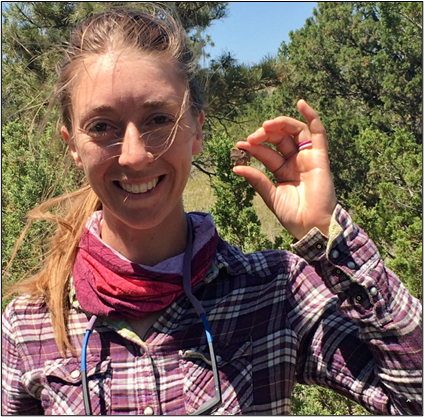
By: Sari B. Dersam

As a local Montanan, I spent a lot of time hiking the landscapes in southwest Montana. I've always been curious about things below the earth's surface, and often miss the beautiful views because I'm staring at the ground. Anytime I'm scanning, I'm always wondering things like, "Why does that feature look like that?" "Why is one side of the fence is greener than the other?" (It's the same soil, right? [wrong].)... among many other questions.
My curiosity for the land and for the hidden and buried is one of the big reasons I became interested in archaeology. The earth conceals a wealth of knowledge if we only know how to decode it. However, my big draw for archaeology was never about the "finding" the artifacts themselves. Many archaeologists carry the mentality that they need to make the "next great discovery," or they strive to check every time period or tool type off a list like we're playing bingo. That outlook has never appealed to me. I hold historical objects and other cultural resources in great regard, and treat them with immense respect. I prefer to leave them on the ground where they are, and when that isn't possible, I don't take their relocation lightly. In my studies, I was mainly concerned about climatic and environmental factors that influenced humans, plants, and animals— and also how humans, plants, and animals affect the environment in return. I was intrigued by what we can learn by using landscape and regional-scale studies to understand what happened in the past, and how it shapes the way our world looks and behaves today.

My whole life I've been staring at the ground wondering about what I now call landscape taphonomy—the study of the processes that shape landscapes. The Holistic Land Management course at Montana State University lit my spark for restoration and mimicking ecosystem dynamics in the present day. The class was mainly focused on restoration through grazing regimes and other holistic practices around agricultural land management. The class did not include much talk about soil microbiology, or, at least, not in much depth. Nevertheless, I was inspired by the works of Gabe Brown, Alan Savory, and many local folks who worked in landscape management. I became immersed in the knowledge that a presence of grazing animals, when applied correctly as part of a holistic management regime, can improve the landscape.
I realize now that, while grazing animals have many functions on a landscape, one important function is that they encourage plants to produce more exudates, the food for the soil biology, by applying pressure to the plants through grazing. If the grazing practices are done in such a way that minimizes stress to the plants, the soil recovers on its own with the help of benevolent plants.
So, what qualifies me to talk about soil biology? I am a Soil Food Web (SFW) certified lab-technician, which means I've taken and passed both the foundation course and lab-tech course through the SFW school. I am qualified to assess the active biology in a soil, compost, compost extract, or compost tea sample. This allows me review and analyze soil conditions, and give general advice about ways to improve those conditions. I cannot give consulting advise, but my training as a researcher can provide the tools you need to get started as you experiment with your own growing system.
Soil improvement starts with creating AEROBIC, microbe-rich compost filled with beneficial fungi, bacteria, protozoa, and nematodes. Your compost recipe will depend on whether your soil needs more bacteria or more fungi (or if you need more of the predators for these groups). I will discuss this in depth in future blogs.
Gardening has been a major interest of mine since I was a small girl. I come from a rural background, and have always had a hand in landscape conservation. My dad, a high school biology teacher, ran a program each summer to grow, catch, and release insects that eat noxious weeds. My favorite biocontrol insect, Cyphocleonus achates (the spotted knapweed root boring weevil), has been part of my life as long as I can remember. As a young kid, I participated in picking these quirky little critters off of knapweed plants and placing them in cups to be released on local farming and ranching properties.
Through my studies as an anthropologist, I became grossly aware of the differences in human-environmental relationships in the past compared to present. Ecosystems are built on predator-prey relationships. Those relationships are frayed or broken on a widespread scale these days. Only tiny microcosms of these "past landscapes" exist, but they are few and far between...though they seem vast when visiting them.
Humans have the ability to mimic and revitalize some of these past relationships. A living soil biology is just one piece in this massive puzzle, but it is an important one.
Ok, so what is the role of microbes in restoration? Many people have heard about phytoremediation, which is the process of remediating a landscape using plants. Plants are useful partners in remediation, but they aren't the only ones. Plants release exudates—a mix of carbohydrates, proteins, and sugars—to attract and feed the bacterial or fungal species that it prefers to partner with. Those bacteria and fungi do many things to benefit the plant. The first is that they create glues to adhere the mineral particles together to allow air and water passage through the soil substrate. The bacteria and fungi also "mine" the various nutrients from the mineral particles and store those nutrients in their bodies. Once the biomass of these organisms reaches a certain level, the predators will eventually be attracted to these locations. Those predators will consume the bacteria and fungi and release nutrients back to the plant right where the plant needs it: next to the plant roots.
Phytoremediation can transform a landscape, but if the soil has the appropriate microbial partners in the proper balance, remediation can occur significantly faster. With a healthy soil—one with bacteria, fungi, and all the predators in their proper balance—nutrient cycling is effortless, water infiltration increases, soil temperatures stabilize, pH levels stabilize, and so many other positive benefits occur.
There are ways to speed up the process of remediation by mimicking mother nature. Mother nature does not pour chemicals on a wide-spread scale to inhibit the growth of weeds. Neither does mother nature flood a system with salts (chemical fertilizers are all salts) to make sure the plants get the nutrients they need. Nature waits for a series of organisms to take hold and the plant communities shift accordingly. For instance, when fungal biomass exceeds the biomass of bacteria, the whole system shifts. Weeds become less numerous. They may show up here and there where a rodent or bird scratches the surface, but the weeds are not a widespread problem, and they do not take over.
Nature goes through phases. She takes her time and values relationships. There is a give, a take, and over time the synergistic relationships compound. I hope to cast light on the practical solutions that allow us to mimic and revitalize through mother nature's wisdom as you follow along.


Comments