
The Jefferson River Project
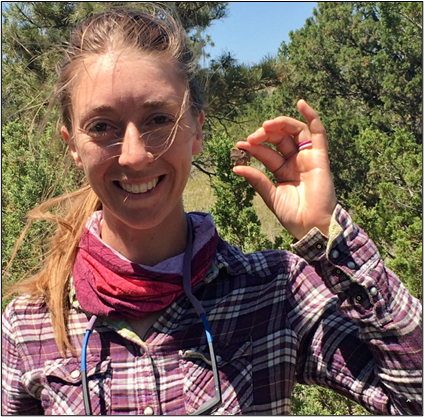
The Jefferson River Project takes place on a private farm along a Pleistocene channel of the Jefferson River in Jefferson County, Montana. The area is on the northwestern edge of the GYE, at the base of the Tobacco Root Mountains foothills.
The site being investigated by AERI is located on an isolated, stabilized T2 Pleistocene terrace within the river channel, and sedimentation suggests that the terrace's depositional environment was driven by persistent, low-energy flood events, as evidenced by overbank deposits.

AERI researchers were initially drawn to the site after a complete bifacial tool, technologically consistent with Early Archaic or Late Paleoindian technologies, was found eroding out of a frequented moose wallow.
Further organic duff removal from the surface of the locality revealed varying forms of lithic debitage and formal tool fragments, as well as a complete Scottsbluff hafted knife or drill (13cm) made out of a non-local gray chert. This discovery immediately sparked interest in the site, but due to scheduling and funding constraints, it could not be addressed until the 2025 season.
Though it was the Paleoindian association that initially attracted AERI to this locality, further investigation of the now secondary channel of the Jefferson River, on which the site resides, revealed itself to have once been the primary channel of the river system, and was even the original river channel navigated by the Corps of Discovery when the Lewis and Clark Expedition came through the Whitehall area between July 26th and July 31st in 1805. The channel was diverted to its current course sometime after 1805 and before 1840.
Over a 7-day session in August of 2025, AERI scientists, student researchers, U of M students, volunteers, and local members of the public joined us as we slowly unveiled the history of this site and its many potential uses.
The site, now known as the Kingfisher site, contained an unexpectedly high density of formal, highly curated lithic tools distributed stratigraphically across sequences of overbank deposits.
Considering diagnostic surface artifacts linked to the Scottsbluff or broader Cody techno-complex recovered, it should have been unsurprising that other diagnostics encountered could be of the same age, yet it was still surprising when, less than 15cm below the surface in a level where multiple flakes were recovered, the base of a Paleoindian Fishtail techno-complex projectile point was discovered. Even more exciting was that this was a point style representing the older Fishtail Complex variant regionally dated in sites like Mummy Cave, Medicine Lodge Creek, Game Creek, Osprey Beach, and the Lawrence site to between 10,705 and 10,330 Cal BP.

One of the 1m x 1m test units was taken further down from the main artifact cluster, only to continue to encounter beach sands and overbank deposits for another 40cm before encountering a second, deeper cluster of bifacial tools, consisting of different raw material sources and production styles, including one artifact that is reminiscent of a Folsom ultra-thin biface.
Yet the artifacts encountered were restricted to different levels of overbank deposits, potentially indicating that the site was heavily reoccupied during the early Holocene, with technologies possibly dating as early as 12,000 years before present and spanning up to 8,000 years before present.
A total of 15 formal bifacial tools were recovered from the site during the 2025 season, including 5 diagnostic points associated with the Middle and Late Paleoindian periods. After preliminary analysis is complete, AERI will return to the Kingfisher site in either the 2028 or 2029 field seasons to continue our investigations into this extraordinary site!
Read the whole 2026 annual report here:
AERI is a 501(c)(3) nonprofit that focuses on research and education regarding the natural and cultural histories of mountainous ecosystems. We synthesize our research findings with traditional wisdom to improve human-environment relationships and conservation practices in these beautiful landscapes.
AERI conducts research in the Greater Yellowstone Ecosystem (GYE), which is culturally significant—either through ceremony or as a direct homeland—to at least 49 affiliated tribal groups. We respectfully acknowledge the peoples on whose traditional territories we reside and work. We work to honor their relationship to these lands, since time immemorial, and to follow their example in caring for this place for generations to come.


Lúc nghỉ ngơi, mình mở UU88 để xem thử vì trước đó tình cờ nghe một vài người nhắc tới. Mình chủ yếu quan sát giao diện và cách website sắp xếp các chuyên mục, Mình đọc thử một vài nội dung chưa có ý định tìm hiểu hết nội dung bên trong. Tiêu đề lớn giúp người xem dễ nhận ra từng khu vực khi kéo xuống. Sau vài phút lướt trang, mình thấy các khu vực được chia khá rõ, khoảng cách giữa các phần hợp lý nên nhìn tổng thể không bị rối. Tiêu đề từng mục có độ lớn vừa phải, giúp theo dõi vị trí khi kéo xuống dễ hơn.
Mình bắt gặp website https://h19gene.com/ khi đang tìm tài liệu liên quan đến một nội dung mình quan tâm nên đã mở vào đọc thử. Mình chỉ lướt qua để tham khảo cách họ trình bày và phân chia các chuyên mục. Cảm nhận đầu tiên là bố cục khá sạch, từng nhóm nội dung được tách ra rõ ràng nên không tạo cảm giác quá tải. Tổng thể, website có cách trình bày gọn và khá dễ theo dõi. Các tiêu đề có kích thước phù hợp, giúp người xem dễ theo dõi vị trí khi kéo xuống
Có lần đang đi du lịch nước ngoài thì bỗng nghe thấy có một nhóm người trên máy bay bàn tán về 33WIN nghe những lời họ nói thì có vẻ như trang web này được khá nhiều người biết đến. Mình vốn không để ý mấy chuyện này nên chỉ nghe ké vài câu rồi nhớ tên. Sau đó vì tò mò mình mới thử tìm xem, ấn tượng đầu tiên là giao diện khá thân thiện, các mục được chia rõ và cách trình bày nhìn tương đối thoáng.
Thấy BM88 được chèn vào và được mọi người nhắc tới nhiều. Mình bấm xem cho biết, để xem cách trình bày và cấu trúc nội dung. Lướt nhanh thì thấy tổng thể khá gọn gàng, tạo cảm giác đáng tin cậy. Với mình, chỉ cần nội dung gọn gàng như vậy là đủ để mình nắm bắt thông tin cơ bản.
Vào thời gian rảnh mình hay lướt mạng, mình thấy nhiều người kể cả bạn bè mình hay bàn tán về trang 789WIN đặc biệt là về các thông tin thể thao và các trò trơi giải trí trực tuyến. Mình không đi sâu vào từng chi tiết mà chỉ dành chút thời gian để xem cách phân chia các mục và giao diện. Mình thấy nội dung gọn gàng đầy đủ để nắm bắt thông tin cơ bản khi vào thăm trang.