
The Trail Creek Project
The Trail Creek Project is on private land near the mouth of Trail Creek drainage and Paradise Valley, Montana. The private holding straddles either side of Trail Creek, encompassing both T1 terraces on either side of the creek system.
The landowner has recorded more than 20 diagnostic projectile points on his land, spanning the Late Paleoindian period (represented by the Fishtail and Fredricks typologies) through the Late Precontact period. The largest representative samples are associated with the Early Archaic time frame, linked to robust side-notch projectile points characteristic of the Early Holocene warming period. The landowners have also recorded multiple instances of older, desiccated bone fragments eroding out of the bank at several locations, often associated with lithic debitage and charcoal fragments.
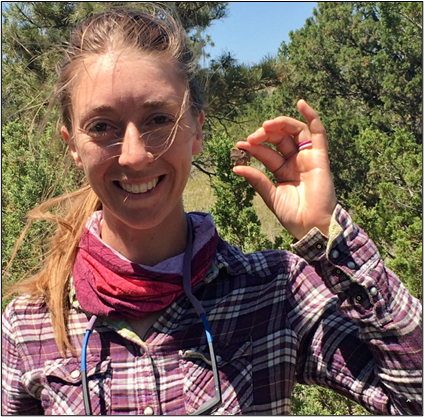
AERI researchers and volunteers spent 5 days in October of 2025 conducting preliminary research on the T1 terraces and conglomerated bedrock hillsides of the property to prepare for longer ongoing investigations of the site in years to come.
This included an intensive pedestrian survey of portions of the creek terraces, where associated carbon staining and eroding bison bones were observed exposed on the creek bank.
AERI conducted a sequence of auger probes to depths ranging from 35cm to 120cm below the ground surface, with most probes revealing evidence of cultural occupation and, in many cases, multiple depths of reoccupation in the auger-probe-recovered lithic materials.

In a particularly dense cluster of bone tools, lithic debitage, yellow ochre nodules, and carbon, AERI researchers set up a 2m x 2m block test unit and began excavation, which will continue into the 2026 and likely 2027 field seasons. During investigations, AERI researchers, Park County students, youth, and members of the public documented multiple exciting aspects about the Trail Creek Project's history, including compelling evidence of ancient fishing behaviors.
The AERI team recovered more than 270 artifacts from the Trail Creek site during preliminary investigations over the 2025 field season, including varying polished bone tools, including potential bone fishing implements, worked freshwater shell fragments, and potential net weight sinkers made from local river stones. The preliminary investigation also yielded ample lithic debitage from multiple sources, including local quartzites, cherts, agates, and obsidian.

No formal diagnostic lithic tools were recovered during the 2025 assessment, but over the five-day period, AERI researchers and volunteers were hardly able to scratch the surface of the site. The collected evidence revealed a diverse landscape, heavily reoccupied across multiple areas throughout the properties.
The 2026 season will focus on excavation, subsurface data collection, and further surveying of the property’s hillslopes, in addition to a thorough geophysical and palaeobotanical assessment of the site's multiple periods of occupation.
The Trail Creek project will be a major focus of a community and student-led research project documenting the deep past of human-landscape interactions and ancient conservation methods present in the landscapes of Park County.

K-12 students and youth educators will investigate and present their findings to the Park County Community later in the winter of 2026. They will also aid in the design and content of an exhibit documenting the project and its results, to be unveiled at the Yellowstone Gateway Museum in the winter of 2026, after the project.
The 2026 field sessions for the Trail Creek Project will be held in September. Please check in at www.alpineresearch.org/projects to see dates and to sign up!
Read the whole 2026 annual report here:
AERI is a 501(c)(3) nonprofit that focuses on research and education regarding the natural and cultural histories of mountainous ecosystems. We synthesize our research findings with traditional wisdom to improve human-environment relationships and conservation practices in these beautiful landscapes.
AERI conducts research in the Greater Yellowstone Ecosystem (GYE), which is culturally significant—either through ceremony or as a direct homeland—to at least 49 affiliated tribal groups. We respectfully acknowledge the peoples on whose traditional territories we reside and work. We work to honor their relationship to these lands, since time immemorial, and to follow their example in caring for this place for generations to come.


Comments